Stay updated with the latest announcements and events from the Jose Maria Sison Legacy Foundation. Discover important news and updates directly from the foundation.
Foundation News
Rejoice, Rectify, Remember: Julieta de Lima’s birthday tribute to Ka Joma
February 8, 2026
This birthday tribute was written for one of four events in February 2026 to commemorate the 87th birthday of Ka Joma and the one-year anniversary of the JMS Legacy Foundation. For more information on the month of events, please see here. Jose Maria Sison, or as many of you knew him, Ka Joma, was born from one of the richest families in Cabugao, Ilocos Sur, the sixth of seven surviving children, on February 8, 1939. Today would have been his 87th birthday. He was almost two years old when the Japanese fascists invaded the Philippines on December 8, 1941, landing...
This birthday tribute was written for one of four events in February 2026 to commemorate the 87th birthday of Ka Joma and the one-year anniversary of the JMS Legacy Foundation. For more information on the month of events, please see here.
Jose Maria Sison, or as many of you knew him, Ka Joma, was born from one of the richest families in Cabugao, Ilocos Sur, the sixth of seven surviving children, on February 8, 1939. Today would have been his 87th birthday.
He was almost two years old when the Japanese fascists invaded the Philippines on December 8, 1941, landing in Aparri, Vigan and Legaspi, rapidly advancing toward Manila until the fall of Bataan on April 9, 1942 and the surrender of Corregidor on May 6 of the same year whereupon the defeated allied forces were subjected to the Bataan Death March during which 7,000 to 10,000 of some 75,000 prisoners died from starvation, disease, and execution.
The Japanese occupation of the Philippines during World War II lasted for three years, 1942-45, during which the Japanese set up a puppet government under President Jose P. Laurel and committed widespread atrocities, including rape, human experimentation and mass killings.
The Filipino people’s main line of defense at the time was the HUKBALAHAP, the armed wing of the old Communist Party waging an antifascist war against the Japanese occupiers. After Japan’s defeat and surrender on September 2, 1945. The US then granted fake independence to the Philippines on July 4, 1946, while retaining its bases and full economic power.
The young boy heard and absorbed his parent’s dissatisfaction with the falsity of the grant of independence that came with the so-called Parity Amendment, especially because it granted US citizens and corporations the right own and exploit natural resources, including lands in the Philippines but did not grant the same right to Filipinos in the United States. A large portion of the Sison land, a whole island—Salomague—was designated a US base and this really angered the family.
Joma came of school age in 1945, and unlike his elder siblings who were sent to convent schools, was enrolled in the public school where his classmates were children of tenant peasants working the lands owned by his family. From them, he heard stories of how their families were being exploited and oppressed by his own landlord family. Thus early on, he learned of the great class divide between and rich and the poor.
In Grade I he was terrified to go to school because he had not learned to read and write as his parents had forgotten to teach him the Catechism. However, his Yaya (nanny) took it upon herself to teach him and thus he learned to read and write enough to go through Grades I and II. His family had regarded him as a dumb ox, despite the feat of having memorized the Latin responses of a sacristan in a mass and having written a short story published in the Ilocano weekly Bannawag. It was a story about a poor boy and a rich girl to which he gave a tragic ending, departing from the usual denouement of class reconciliation.
He started to top his class from Grade IV until he finished the elementary grades. He served as a sacristan every Sunday mass for which he received 50 cents, but he was glad when there were funeral masses because he received a whole peso.
While at the close of World War II his classmates were still awed by GI Joes giving them Hershey’s chocolates and Wrigley’s chewing gum, Joma started to gain an understanding of the anti-Spanish and anti-US phases of the Philippine Revolution from 1896 onward because of stories he heard at home and those he read in school, especially with the encouragement of one of his teachers in the fourth grade, Luzber Gazmin who was a staunch patriot.
His father had a strong feudal orientation, comfortable with the land he had inherited. The souring of investments he made in Manila before and after World War II served to discourage him from breaking into any new enterprise. In his investments, he acted as a feudal lord, leaving the management to his wife’s relatives.
At the same time, he had strong anti-imperialist sentiments. He was a vocal admirer of Claro Mayo Recto who in the early 1950s espoused the anti-imperialist line. He also admired Recto for being a master of the Spanish language, a fellow product of the Jesuits and opponent of the US-made hero Ramon Magsaysay who touted himself as a champion of land reform through a CIA-manipulated media hype as a poor man and defender of the masses, although he was a big landlord. With strong CIA and US imperialist backing, Magsaysay won the presidency in 1954, but his land reform never came to pass except for the distribution of a few thousand hectares of raw public land for resettlement by deactivated military personnel and some rebel surrenderers.
For his secondary schooling, Joma was sent to Manila and was first enrolled at the Ateneo de Manila, which was impressed on him as the best high school in the whole country. He had strong feelings of fulfilment on finally getting on track of his family’s tradition of being educated by Jesuits like his father and three elder brothers—Ramon, Francisco and Antonio.
His father had worked out Joma’s whole life in his own mind. He was exceedingly pleased that Joma finished his elementary education as valedictorian and urged him to always top his class, excel in writing and oratory, get a bachelor’s degree in journalism, take up law, top the bar examination, proceed to Harvard University for higher studies, marry a beautiful and wealthy woman, come back to Ilocos and start the climb to the presidency of the country.
His father was projecting not only his own ambitions but a composite picture of his son from the outstanding features of national political leaders, of which his favorite point of reference was Claro Mayo Recto who was not only a summa cum laude but a maxima cum laude. Next was Isabelo de los Reyes, the nationally acclaimed founder of the modern trade union movement in the Philippines who was a relative by affinity through the Sison relations with Don Mena Crisologo and the Serrano intermarriages with the Florentino family of Vigan, Ilocos Sur.
Joma received the first long lasting political jolt of his life during his first week at the Ateneo when he heard his Jesuit teacher ridicule Andres Bonifacio, founder and leader of the Katipunan, which started the Philippine revolution of 1896, as a mere thug from Tondo and Claro Mayo Recto as a crazy Communist. As his Jesuit mentors tortured the subject of communism ad nauseaum, the more he became curious about the subject.
He wanted to read the original texts of Communist thinkers but could not find any. He could only read the speeches of Recto, which he did so avidly, agreed with them and found the diatribes of the Jesuits silly.
Despite the fact that he was rated C for effort and his unusually large absences from school, he was an honor student but not at top of his class. It was his grade in religion that brought down his general grade average. He resisted the philosophical view that consciousness precedes matter. And throughout his high school years, his teachers in religion would dislike him for his resistance and gave him low grades in the subject.
In 1954, he finished his second year at the Ateneo as an honor student. But he was honorably dismissed from the school on the suspicion that he had thrice led his classmates to absent themselves from classes in protest against a Jesuit teacher as well as by standing up to authority and by incurring so many absences.
For his third year in high school, he was enrolled in San Juan de Letran, another exclusive boys school for the well to do run by Dominican friars. Here he was first disgusted by the arbitrary way the students were graded in all subjects. He made it a point to make perfect scores in all subjects but lower marks were put on his periodic report card. He graded low in religion and was even given a failing grade.
Despite his problem with the courses in religion, he was always an honor student at the end of every semester. He excelled in creative writing and declamation and was even made the literary editor of The Lance, the school organ. He read a wide range of books outside the curriculum which he found much more interesting that he dropped the idea of being at the top of his class. He was also preoccupied with writing a novel in those two years at Letran.
The novel was about the agrarian problem in Luzon, involving sugar workers. The central character, confronted with the fact of a decaying feudalism, involving specific social and historical details, scenes and incidents of an agrarian community. Aside from the novel, Joma wrote and published a book of poems, Brothers, where he employed revolutionary aesthetics, inspired not by the conventions of literature but by the need to present facts in Philippine social life.
Joma enrolled for college education at the University of the Philippines in 1987 despite his father’s desire to have him enrol at Ateneo de Manila. As a college student, he was unstudious but nonetheless he got good grades enough to graduate as a cum laude. He was much more interested in extracurricular pursuits, like engaging in philosophical, socio-political and cultural discussions with a group of friends, together with some university professors, among them the eminent historian Teodoro Agoncillo and the logical positivist head of the department of philosophy who held weekly sessions at the porch of his residence with a group of students.
They discussed McCarthyism, the Cold War, the execution of Julius and Ethel Rosenberg, philosophical works of Bertrand Russel, Simon de Beauvoir, Jean Paul Sarte, Karl Popper, etc., as well as events in the UP campus, the dominant religio-sectarians who were in control of university policies, the socioeconomic and political conditions of the country. With Agoncillo, they discussed events in Philippine history and the response of the Filipino to these events.
From these discussions, Joma honed his outlook which led him to the great philosopher, Karl Marx, and vowed to follow his teachings by addressing the socio-political issues confronting the people.
His first attempt at addressing social issues was producing the concept of the Alliance for Liberation and Socialist Advance (ALSA -meaning rise) which he discussed with close friends who all supported the project. However, just as they were about to proceed with organizing, Joma chanced upon the writings of Mao Zedong which he avidly read and studied, thereby realizing that he was on the wrong track. Mao made him realize that the country and its people first needed to be freed from feudal and semifeudal exploitation and oppression before being aroused, organized and mobilized to build socialism.
Thus, he proceeded in 1959 to organize the Student Cultural Association of the University of the Philippines (SCAUP) not only to oppose the pro-US imperialist reactionaries who dominated the liberal arts faculty and the general run of UP students in the UP Student Catholic Action but also to advocate national liberation and democracy.
SCAUP had a two-level educational program for all members: the openly promoted national democratic courses on a comprehensive range of issues involving the contradiction between the US dominated ruling system of big compradors and landlords and the national and democratic demands of the people; and the discreet Marxist-Leninist-Maoist courses on revolutionary theory and practice.
Not satisfied with their limited influence, Joma and SCAUP members went beyond the university, to proseletize and laid the basis for organizing a national comprehensive youth organization, Kabataang Makabayan (KM) or Patriotic Youth, among students of down town universities. Using the resources of the UP Student Council, SCAUP invited student leaders from all over the Philippines to conferences at the UP to promote the ideas of national freedom and democracy against the local exploiting classes and their US imperialist masters. In this regard, SCAUP parented and nurtured subsequent national democratic and revolutionary organizations that came to be, including the Communist Party of the Philippines.
It would be instructive for current national-democratic activists to learn from their predecessors how to spread the word in the current anti-corruption, anti-bureaucrat capitalism and anti-fascist campaigns and thus advance the movement not only nationwide but also worldwide among overseas Filipinos and solidarity activists.
The entire decade of the 1950s was a period of intense reaction and deep ebb in the revolutionary movement. The US and local reactionaries were riding high on the Cold War long after McCarthyism had become discredited. SCAUP gained national renown when it had its first big opportunity to organize in a united front with other campus organizations the mass protest in March 15, 1961 opposing the congressional witch hunt conducted by the Congressional Committee on Anti-Filipino (CAFA) activities against UP faculty members and students who were accused of writing or publishing Marxist materials in violation of the Anti-Subversion Law, including Joma’s Philippine Collegian article “Requiem for Lumumba.” This was the first anti-imperialist and anti-feudal mass protest action after a decade of intense reaction since 1950. Five thousand students surged into the congressional hall to literally scuttle a hearing of the Committee on Anti-Filipino Activities.
As a result of the anti-CAFA mass action, Joma’s UP teaching fellowship was terminated. But he gained the time to do further revolutionary student organizing in several universities albeit clandestinely and encouraged the formation of progressive student organizations nationwide. In 1962, he joined the trade union movement and the Workers’ Party where he did research and education work. As vice chairman for education of the Workers’ Party, he organized seminars for trade unionists from several major labor federations and large independent union. Then he established the youth department of the Workers’ Party, which would become a source of young workers for Kabataang Makabayan.
From his study and analysis of conditions in Philippine society, Joma wrote articles on land reform and from early 1963 gave refresher courses to peasant leaders and veteran fighters of the old people’s army who recommended their children and other young relatives to become members of KM at the preparatory phase of its founding at the beginning of 1964.
Kabataang Makabayan grew all over the country, not only among college students but also among other youth—workers, peasants, and high school students. Discussion groups and schools for national democracy were set up. Joma wrote Struggle for National Democracy (1967) for educating the recruits to Kabataang Makabayan. The articles in the book were statements and speeches written as tools for arousing, organizing and mobilizing the people.
Joma was a very prolific writer. He could dash off a press statement or a manifesto so quickly that friends joked he had a trunkful of these from where he whipped one out whenever necessary. He was a member of the UP Writers Club, the National Press Club, the Afro-Asian Journalists Association and the Afro-Asian Writers Bureau. He contributed articles to international journals such as the London-based Eastern World and the Hong Kong-based Eastern Horizon. He founded and became editor-in-chief of Progressive Review until he went underground to reestablished the Communist Party of the Philippines. Of course he became the editor and main writer of Ang Bayan, the organ of the Communist Party of the Philippines from the reestablishment of the Party in 1968 until his capture and imprisonment in 1977.
Towards the CPP’s founding in 1968, Joma conducted intense ideological, political and organizational work. Aside from drafting and discussing basic documents, including the rectification document, “Rectify Errors and Rebuild the Party”, in preparation for the Congress of Reestablishment, we produced revolutionary literary and artistic works to inspire the masses.
At the core of Kabataang Makabayan were proletarian revolutionary cadres, who had become members of the old merger party of the Communist and Socialist Parties (OMPCSP) since 1962. These cadres demanded a rectification movement to criticize the major errors and shortcomings of the old merger party since the 1930s. The Lava revisionist renegades opposed the rectification movement and sought to expel the proletarian revolutionaries, leading them and their senior comrades to separate from the Lava revisionist renegades in April 1967, to intensify the rectification movement and to begin preparations for the reestablishment of the Communist Party of the Philippines (CPP) under the theoretical guidance of Marxism-Leninism-Maoism on December 26, 1968.
As founding chairman of the Communist Party of the Philippines, founder of the New People’s Army and the National Democratic Front, Joma applied dialectical and historical materialism to reveal the fundamental nature of the semicolonial and semifeudal system in the Philippines and how to change it. These were detailed in his writings, such as the “Program for a People’s Democratic Revolution,” Philippine Society and Revolution, “Specific Characteristics of our People’s War, “Our Urgent Tasks,” and other subsequent writings. Even while in prison, he was able through visitors to smuggle out significant writings that helped to guide the course of the revolutionary struggle led by the CPP. He was a Marxist-Leninist-Maoist and a persistent revolutionary fighter.
When ranking members of the Party leadership were spreading the claim that the Marcos dictatorship had brought about industrialization to the Philippines, Joma released through an extended interview with me “On the Mode of Production in the Philippines” theoretically elucidating and clarifying the nature of the continuing semicolonial and semifeudal nature of Philippine society.
A powerful upsurge of the antifascist movement propelled by the revolutionary forces followed when Marcos had his intrasystemic rival Benigno Aquino assassinated in 1983. It pushed the US Pentagon together with the US State Department and other US agencies to drop Marcos. It was Ka Joma’s well circulated paper “On the Losing Course of the Armed Forces of the Philippines” written under the pseudonym N.T. Umili that swayed such a course of action taken by the aforementioned US agencies even as this entailed a split within the Armed Forces of the Philippines (AFP).
The antifascist upsurge resulted in the people’s uprising supported by the anti-Marcos reactionaries and elements in the reactionary AFP that overthrew the Marcos fascist dictatorship in 1986. Despite strong US and AFP opposition, President Corazon Aquino was compelled to have Joma released from prison.
Upon release, Joma immediately resumed revolutionary activities, delivering a series of ten lectures at the Asian Institute of the University of the Philippines clarifying the nature of the regime of the new president as the same pro-US reactionary regime but with a liberal democratic facade; and setting up Partido ng Bayan, a political party to participate in elections openly advocating a program for national liberation and democracy.
The EDSA uprising had brought the attention of the peoples of the world in the Philippines and Joma thought it opportune to go on a worldwide lecture tour for carrying out an information campaign about the Philippine revolutionary movement and also to visit socialist and anti-imperialist countries. The tour started with Singapore in June 1986 and ended in the Netherlands the following year when Aquino cancelled his Philippine passport on September 16, 1988. The lecture tour brought him to dozens of countries and scores of cities—New Zealand, Australia, Thailand, Japan, Hong Kong, India, Netherlands, Norway, Sweden, Denmark, Belgium, West Germany, France, England, Albania, Switzerland, Italy, Algeria, Greece, East Germany, China, Democratic People’s Republic of Korea, Yugoslavia, Nicaragua, Cuba, Mexico, Spain and Portugal.
He lectured in almost a hundred universities, and attended important meetings and conferences, visited and exchanged views with parliamentarians, trade union leaders, women activists, progressive writers, representatives and leaders of national liberation movements and solidarity activists.
His plan to return to the Philippines and continue with revolutionary work in his homeland were delayed when Rolando Olalia, the chairman of Partido ng Bayan was assassinated, together with his driver Leonor Alay-ay and the Party leadership asked him to stay abroad until arrangements could be made for his return. But successive plans for his return were all aborted so he was forced to seek asylum and stay in the Netherlands.
From his base in Utrecht, he participated with contributions to international conferences and fora. He founded the International League of Peoples’ Struggle as a broad anti-imperialist united front to arouse, organize and mobilize the people of the world against the US-led imperialist system of exploitation, oppression and wars.
As chief political consultant of the NDFP, he set the line that the struggle for a just and lasting peace is the same as the struggle for national liberation and democracy against US imperialism and the local exploiting classes. There can be no just and lasting peace for as long as the roots of the armed conflict are not addressed. This is clear in the framework agreement titled The Hague Joint Declaration of 1992 signed by the conflicting parties.
He consistently used Marxist-Leninist-Maoist political economy to investigate new exploitative mechanisms and patterns of neocolonialism and globalization under imperialism—including those that have emerged and have been dominant in formerly socialist (or nominally, or just aspirationally socialist) countries, as well as those in the so-called “Asian tigers” and the BRICS member-states. Joma continued to write the anniversary statements for the CPP, NPA and NDFP until 2022. For the CPP Second Congress he drafted the new Program for the People’s Democratic Revolution and the revised CPP Constitution. He enjoined the Congress to wage a rectification campaign to combat currents of conservatism which had started to creep among revolutionary ranks. In these statements, he continued to call on all Party cadres and members to constantly analyze and sum up the international, the national and the Party situation and undertake necessary rectification at every given time to strengthen the Party and the revolutionary movement.
In its tribute to Joma, the CPP Second Congress called him “the torch bearer of the international communist movement. … and stated that with the “treasure of Marxist-Leninist-Maoist work that Ka Joma has produced over the past five decades of revolutionary practice, the Party is well-equipped in leading the national democratic revolution to greater heights and complete victory in the coming years.”
Let me sum up Joma’s ideological, political and organizational achievements. He adopted the fundamental principles in the three components of Marxism—materialist philosophy, political economy and scientific socialism—as laid down by Marx and Engels and applied these on the concrete conditions of his own country.
By following Lenin’s identification of the law of the unity of opposites, as the most fundamental of the laws of contradiction, he deepened our understanding of the law of materialist dialectics. From Mao Zedong, he learned how social practice encompasses production, class struggle and scientific experiment as the source of correct ideas. He learned the dialectical relationship between knowledge and social practice; as well as that of perceptual and rational levels of knowledge in the process of cognition.
He learned from all our great Marxist predecessors that in general, the forces of production are primary to the relations of production; and the mode of production is primary to the superstructure. But in the process of sustained revolutionary change, the resulting relation of production and superstructure can play the primary role. The former releases the forces of production from the old fetters and the latter enhances the mode of production.
He taught us what he learned from his Marxist predecessors that class character is determined not only by the ownership of the means of production, the role in the production process and the distribution of the social product but also by the mode of thinking by which social production is carried out. He understood and taught us the dialectical relationship between social being and social consciousness and laid stress on the need for us to continually revolutionize our consciousness through the process of cultural revolution.
He defined culture as the reflection of economics and politics, with which it has a dialectical relationship. In art and literary theory, he called for the reflection of the revolutionary class struggle and for revolutionary workers, peasants and soldiers to be depicted as heroes. He practiced revolutionary romanticism in writing poetry and declared that art and literature are indispensable methods for educating the masses.
He was inspired by the teachings of his great predecessors, regarding historical materialism, particularly the state and revolution in class society. He passionately espoused the revolutionary essence of Marxism; asserting that the proletariat must wage class struggle, seize political power, and establish the socialist state as a class dictatorship of the proletariat against the bourgeoisie.
In revolutionary practice, he stressed the importance of the concrete analysis of concrete conditions, social investigation and mass work, combatting all forms of idealism, subjectivism and “Left” and Right opportunism and taking the mass line in order to transform correct ideas into a material force.
He acquired a deep understanding of the critique of capitalism and outline of scientific socialism by Marx and Engels as well as the critique of monopoly capitalism or modern imperialism and the realization of socialist revolution and construction by Lenin and Stalin.
He extended and further developed our knowledge of Marxist political economy and scientific socialism by studying and the positive and negative lessons from building socialism in the Soviet Union, by leading the criticism and repudiation of Lavaite revisionist renegades in our country in the first rectification movement in preparation for the reestablishment of the Communist Party of the Philippines in 1968 on the theoretical foundation of Marxism-Leninism-Maoism.
He was guided by the teachings of the great Lenin regarding the building of the Communist Party as the advanced detachment of the working class. He introduced the rectification movement as the method for ensuring the ideological, political and organizational strengthening of the proletarian revolutionary party.
He pursued the theory and strategic line of protracted people’s war that guides the revolutionary forces in various forms of armed struggle. He led the Party to engage in the revolutionary united front to arouse, organize and mobilize the people in their millions for the armed revolution. At the same time, he ensured the vanguard role, independence and initiative of the working class party. He advocated the building of organs of political power at various levels—barrio, municipality, province and upward—to constitute the people’s democratic state.
He led our Party and other revolutionary parties worldwide to stand for socialism and repudiate modern revisionism by exposing the degeneration of the Soviet Union from being socialist to being monopoly bureaucrat capitalist with a general tendency towards social-fascism; by opposing the neocolonialism of the two superpowers, US imperialism and Soviet social imperialism and most important of all by waging the Philippine revolution self-reliantly and in the spirit of international solidarity and proletarian internationalism.
He integrated the universal theory of Marxism-Leninism-Maoism on the concrete semicolonial and semifeudal conditions of the Philippines under the class leadership of the proletariat within the context of the world proletarian-socialist revolution and by doing so, we can be proud of him as a great Communist thinker and leader.
Ka Joma lives on in the perseverance of the revolutionary forces and masses in the struggle against imperialism and all reaction. Let us carry on his legacy by winning the battle for democracy to open the gates to socialism. Let us build on the strong Marxist-Leninist-Maoist foundation that Ka Joma helped build with his works and deeds and advance the people’s epic—the revolutionary movement as an endless movement of strength.
Let me end with Ka Joma’s “The Giant Oak”, his tribute to the great revolutionary Mao Zedong, written on December 26, 1993:
In the bitterness of winter
The giant oak stands erect,
A hundred years old,
A tower of countless seasons.
The mayflies of summer
Are no match to the oak
And the merciless cold.
He who has departed
But whose spirit lives on
And cannot be exorcised
By all sorts of sorcerers
Is sometimes carved out
From the branch of the oak
In the image of his foes
For rituals to steal
The magic of his name.
There are the kisses of betrayal
On the parchment,
Droning incantations of sacrilege
And myths of infamy
Against his great memory.
When foes are haunted
By his thoughts and deeds,
They are in mortal fear
Of the living force inspired
By the bigger battles ahead.
As the light and darkness
Clash in the horizon
And as the best and the worst
Are driven to define themselves.
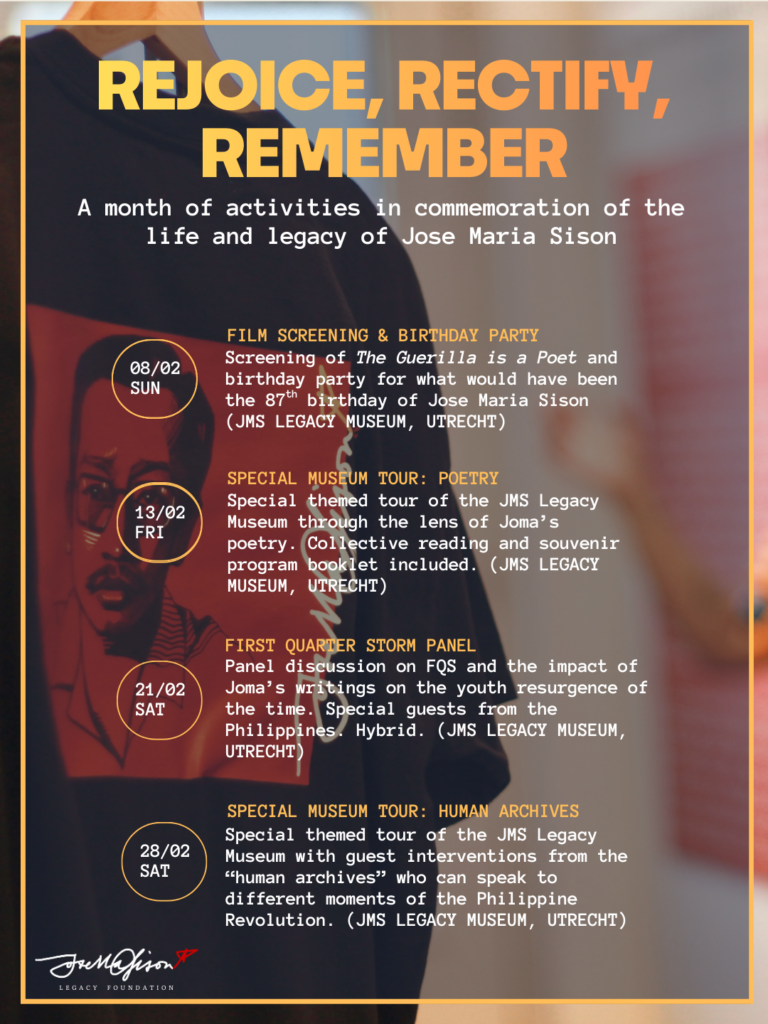
We hope you join us for our February 2026 month of activities to celebrate the 87th birthday of Ka Joma and the Foundation’s one-year anniversary:
- 8 February: Screening of The Guerilla is a Poet and birthday party
- 13 February: “A Life in Poetry and Revolution” museum tour
- 21 February: Keeping the Spirit of the First Quarter Storm Alive: A panel discussion on the legacy of JMS’ writings , the FQS, and lessons for the youth today
- 28 February: “Living Archives, Living Struggle” museum tour
More information on these events can be found on our Instagram and by subscribing to our mailing list.
Loading...