Stay updated with the latest announcements and events from the Jose Maria Sison Legacy Foundation. Discover important news and updates directly from the foundation.
Foundation News
Like Father, Like SONA: A policy of puppetry and endless tyranny
July 29, 2026
Observations on Marcos Jr.’s State of the Nation Address and Ka Joma’s “The Social Basis of a Fascist State” In the penultimate State of the Nation Address (SONA) of his term, Marcos Jr. rattled off a pack of prevarications and psywar under a policy of puppetry and endless tyranny. The Filipino people see through the SONA’s attempts to whitewash the family name, understanding that Marcos, Jr.’s regime is a continuation of his father’s brutal legacy. One needs look no further than Ka Joma’s article, “The Social Basis of a Fascist State,” written in 1986 after the fall of the Marcos...
Observations on Marcos Jr.’s State of the Nation Address and Ka Joma’s “The Social Basis of a Fascist State”
In the penultimate State of the Nation Address (SONA) of his term, Marcos Jr. rattled off a pack of prevarications and psywar under a policy of puppetry and endless tyranny. The Filipino people see through the SONA’s attempts to whitewash the family name, understanding that Marcos, Jr.’s regime is a continuation of his father’s brutal legacy. One needs look no further than Ka Joma’s article, “The Social Basis of a Fascist State,” written in 1986 after the fall of the Marcos Sr. fascist dictatorship to see how, forty years later, Marcos, Jr. continues to walk in his father’s footsteps.
As expected, Marcos’ speech contained no substantial report or policies that would improve the state of the nation. Marcos merely mentioned cosmetic projects, bragged about limited and ineffective solutions to the Filipino people’s daily struggles, and paid lip service to hot button issues to prop up his public image.
His claims to address the effects of the chronic economic crisis in the country and to immediately help the people are no more than empty talking points. The projects he mentioned for health, education, and other social services are all hollow, leaving out many important issues to the everyday Filipino, including the long-standing demands for higher workers’ wages, land for landless farmers, and more.
Marcos disingenuously criticized other government officials for the slow implementation of flood control projects due to corruption, while being the head corrupter-in-chief. For the people, Marcos’ declaration against corruption is meaningless, especially since his billions in confidential funds remain in place. The practice of corruption was also well-known to his father, who used the “trickery of bureaucrat capitalism” in the process of climbing politically and socially to office, including the tactic of scapegoating “intrasystematic opponents and critics.”
Beyond being the chief driver of corruption in the government, Marcos is also the main exacerbator of climate disaster and flooding, allowing destructive quarrying, dredging, mining, and reclamation projects by the bureaucrat-capitalists’ big businesses. He boasted of strong foreign relations and foreign investments even though the Filipino people know that investments by foreign monopoly capitalists continue to pour in only because of subservient policies that grease the wheels for imperialist business interests, keeping our country underdeveloped and nonindustrial. This is straight from the bureaucrat capitalist playbook also employed by his father, whose regime enjoyed the backing of the US and the support of the local ruling classes as long as they were kept happy by lining their pockets with foreign funds:
“The US supported the Marcos fascist state completely and all the way in exchange for more imperialist privileges. The comprador big bourgeoisie and the landlord class also supported the fascist state for so long as it went on a rampage against the communists and the revolutionary mass movement and could get ever increasing amounts of foreign loans to cover deficits in balance of payments, foreign trade and government budget. In pursuit of pseudo-development, the fascist regime went on a spending splurge on infrastructure projects, tourism facilities and other nonproductive or remotely productive projects. The foreign loans allowed an ever increasing portion of tax revenues to be used for military buildup and campaigns of suppression.”
Most of all, Marcos bragged of the US-led Pax Silica Industrial Hub, which does not serve genuine economic development in the Philippines and is nothing more than an aggressive US maneuver to secure its technological military supremacy against global competitors, particularly China. Pax Silica is simply a new wave of imperialist domination and plunder aimed at consolidating US control over strategic territories and resources in the Indo-Pacific region at the expense of the welfare of the Filipino people.
His promises are far from reality and the daily suffering of the Filipino people. His SONA covers up the economic crisis that has resulted in widespread joblessness and deepening impoverishment of the broad masses of our countrymen.
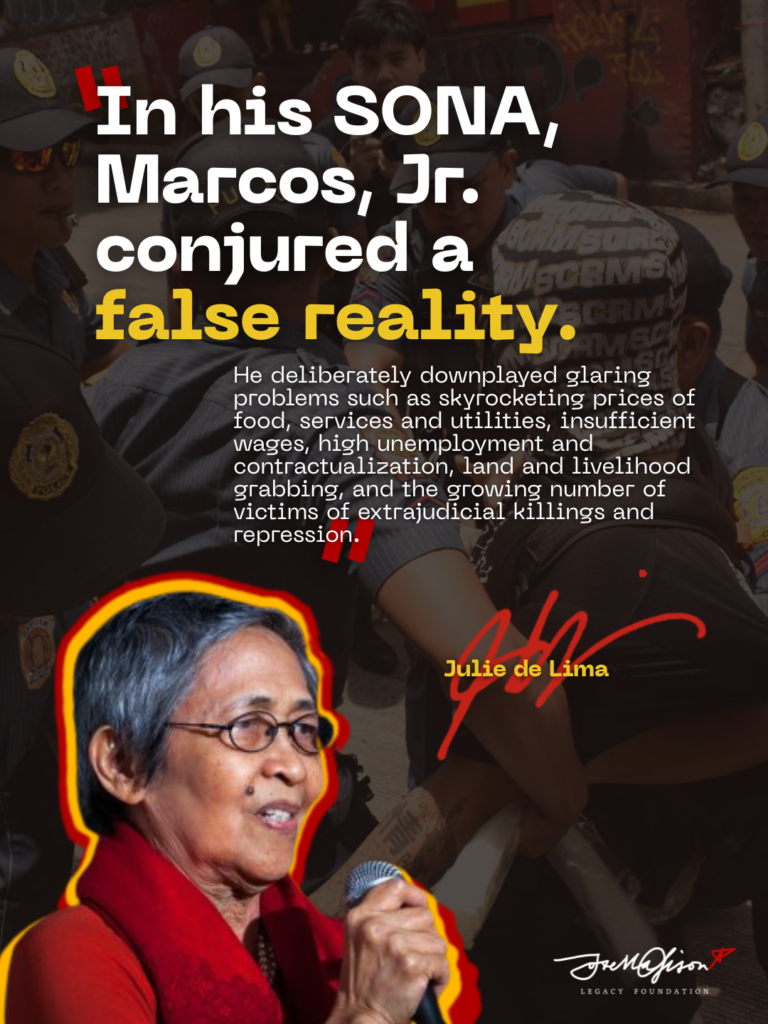
Ka Julie de Lima, reflecting on Marcos, Jr.’s SONA, observed that “In his SONA, Marcos, Jr. conjured a false reality. He deliberately downplayed glaring problems such as skyrocketing prices of food, services and utilities, insufficient wages, high unemployment and contractualization, land and livelihood grabbing, and the growing number of victims of extrajudicial killings and repression.”
Only big businesses, foreign capitalists, and bureaucrat-capitalists would be happy with Marcos’ speech. They all benefit from his corruption, his government’s all-out import liberalization policy, foreign-funded and government-guaranteed infrastructure projects strongly opposed by the people; cheap labor policy, and conversion of thousands of hectares of land to attract foreign investment. As Ka Joma already described in 1986, “the ruling cliques in neocolonial and semifeudal fascist states enjoy the support and are tools of both the US monopoly bourgeoisie and the domestic comprador big bourgeoisie.” Marcos, Jr. is following the model of his father, whose “propensity for puppetry, despotism and corruption coincided with and aggravated the objectively worsening socioeconomic crisis of the semicolonial and semifeudal ruling system.”
The social and economic conditions of the Filipino people remain the same now as during the Marcos, Sr.: “The ruling system remains in grave crisis. The same ruling classes ride roughshod over the people and the two major factions among them are in sharp contradiction. The same AFP which was the main oppressive instrument of the fallen Marcos [Sr.] regime remain intact and continues to oppress the people.” The police arrests of tens of activists during the SONA ng Bayan on July 27 in the Philippines is evidence of the same repressive measures of the state being used to suppress people’s dissent.
Marcos, Jr. continues the reign of puppetry and tyranny rampant under his father’s fascist dictatorship that must be stopped to prevent the complete ruination of the nation, and like his father, the Filipino people can and must rise up to defeat him and the entire ruling system.
*The Social Basis of a Fascist State” can be found in the JMS Legacy Foundation’s compilation, the Little Book on Fascism and How to Fight It.
Loading...